Back to Home
Case Study
Gamifying Corporate Training for a Leading Malaysian Telco
Product Design
Background
Corporate training programs often suffer from an engagement paradox: organizations need teams to retain complex information, but traditional learning management systems require massive time commitments that employees simply do not have.
When a prominent Malaysian telecommunications provider wanted to revolutionize their customer experience (CX) training, they needed to move away from rigid, long-form courses. I led the end-to-end product design for a bite-sized, gamified e-learning mobile application. By borrowing proven engagement mechanics from consumer apps like Duolingo, we shifted their training culture from a mandatory chore to a highly competitive, interactive daily habit.
I led the product design, transforming the client’s high-level vision into a concrete, shippable mobile product. My responsibility wasn’t just confined to Figma; because the application was built using Unity (C#), I actively jumped into the development process to implement the UI layout and structure. This ensured the final product matched our design fidelity perfectly.
I also managed a small design team, guiding one to two graphic designers who focused entirely on creating custom visual assets for our in-app economy.
Problem
Prior to our intervention, the telco's Customer Experience training team relied on two primary methods: periodic physical workshops and a traditional, course-based internal e-learning platform. This setup introduced significant friction:
The Retention Gap: Huge time gaps between quarterly workshops meant knowledge retention was below average.
The Time Tax: The existing e-learning system required massive blocks of undivided attention. Staff members—busy managing frontline telco operations during the day—simply couldn't commit the time.
The platform was severely underutilized, and critical customer service knowledge was being lost.
Research & Process
Validating Learner’s Pain Points
Our collaborative workshops and interviews with the telco staff quickly validated the client's suspicions. The core issues were universally time constraints, platform complexity, and lack of continuity.
The client gave us a clear directive: "Make it the Duolingo of telco training." They wanted a high-engagement, "hop-in, hop-out" experience.
Working Within Limits
With a tight launch timeline, our biggest constraint was managing feature creep. Instead of gambling on unproven, overly complex gamification theories, we made a strategic decision to stick to tried-and-tested behavioral mechanics. We focused heavily on two pillars: meaningful rewards and interactive micro-learning.
Dynamic Content
A key requirement was giving the client total autonomy to add, edit, and remove training modules on the fly. This demanded a full-fledged Content Management System (CMS) to host learning materials, manage the tangible rewards shop, and moderate community posts.
Rather than wasting time reinventing the wheel, our development team strategically leveraged Moodle. However, Moodle is traditionally built for heavy, academic e-learning—not agile, gamified micro-rewards. We had to design massive systemic concessions, mapping out custom middleware workflows so the client could seamlessly manage avatar rewards and leaderboard logic within an ecosystem never originally designed for it. This gave us a bulletproof, secure foundation without blowing past our timeline.
Data-Driven Validation
Proving the app’s value meant we couldn't just rely on "vibes"—we needed cold, hard engagement data. To do this, we designed a custom analytics layer.
I worked closely with the senior system architect to design a bespoke dashboard right within Moodle. Instead of burying the training team under rows of raw database tables, we built an intuitive, visual dashboard. It allowed stakeholders to monitor macro-level organizational performance at a glance and instantly drill down into micro-level metrics—even tracking individual learner progress, completion speeds, and drop-off points to help them refine future training content.
Solution
The Economy of Engagement
We introduced a gamified loop where learners earned digital coins upon completing micro-lessons. To give these coins value, we designed a two-tiered economy:
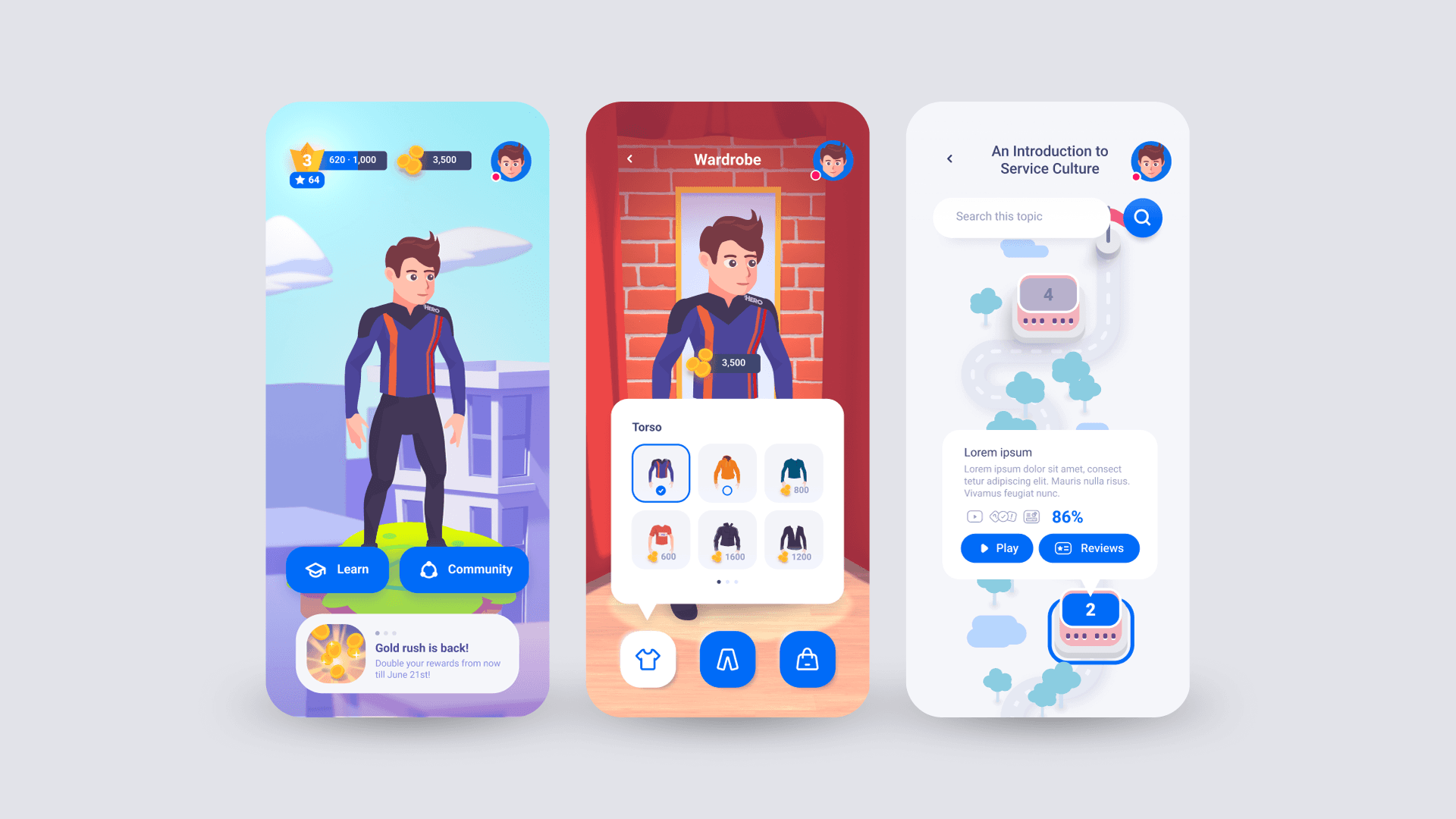
Intangible Identity: Users could spend coins in an in-app shop to customize their personal profile avatar—purchasing gender options, clothing, and accessories designed by our graphic team.
Tangible Rewards: To sweeten the deal, coins could also be redeemed for actual company merchandise and retail coupons.
Combatting Memorization via Smart Repetition
To maximize knowledge retention, we ditched static reading materials for highly interactive quizzes. We built answer-randomization logic into the backend; this ensured users couldn't just casually memorize the layout or tap sequence of a quiz during repeated attempts. They actually had to digest the information to pass.
Fostering Social Proof
We implemented a public leaderboard system. By surfacing top learners across the company, we tapped into a natural sense of friendly competition among the regional teams.
Impact
The launch was an immediate success. The app was so well-received that the leaderboards sparked an organic wave of internal competition. More importantly, the results caught the attention of other departments within the telco, who actively lobbied to migrate their own training databases into our app.
Expansion
This success led the client to immediately retain us for a Phase 2 Expansion, where the goals grew significantly:
The "Map" Progression UI: The client wanted to lean completely into the video game aesthetic. I oversaw a comprehensive UI/UX refresh, transforming the linear lesson structure into a visual progression map.
Scaling Content Architecture: With multiple departments now onboarding content, I collaborated with a skilled UI/UX designer to overhaul the app's navigation and user flows, ensuring the layout remained clean and scalable despite a massive influx of new topics.
Underestimating the Power Users
If I could revisit the initial launch, I would completely overhaul our economic balancing. We drastically underestimated just how competitive and passionate these telco employees would be.
Our power users absolutely demolished the coursework, accumulating a massive surplus of coins far faster than we anticipated. This created an immediate supply-and-demand issue where the in-app shop ran dry of new rewards. While the CX training team gracefully handled this by giving these top users special executive recognition, it was a glaring lesson in economic scaling.
In hindsight, a specialized, data-driven trial run should have been conducted to rigorously test the earn-to-spend ratio. Designing a game loop requires more than a beautiful UI—it requires the mindset of an economy designer.
" width="129.4974px"><path d="M 14.389 129.497 C 6.442 129.497 0 123.055 0 115.109 L 0 14.389 C 0 6.442 6.442 0 14.389 0 L 115.109 0 C 123.055 0 129.497 6.442 129.497 14.389 L 129.497 115.109 C 129.497 123.055 123.055 129.497 115.109 129.497 Z M 19.844 111.512 L 39.153 111.512 L 39.153 49.16 L 19.844 49.16 Z M 111.512 111.512 L 111.512 72.035 C 111.512 55.331 102.044 47.256 88.819 47.256 C 75.587 47.256 70.019 57.56 70.019 57.56 L 70.019 49.16 L 51.499 49.16 L 51.499 111.512 L 70.019 111.512 L 70.019 78.781 C 70.019 70.011 74.056 64.794 81.783 64.794 C 88.886 64.794 92.296 69.808 92.296 78.781 L 92.296 111.512 Z M 29.405 40.997 C 35.714 40.997 40.822 35.846 40.822 29.491 C 40.822 23.137 35.714 17.986 29.405 17.986 C 23.097 17.986 17.986 23.137 17.986 29.491 C 17.986 35.846 23.097 40.997 29.405 40.997 Z" fill="rgb(255, 255, 255)" height="129.4974px" id="tQhef5xiF" width="129.4974px"/></g></svg>)
" width="147.71161370654292px"><path d="M 0 100.243 L 91.308 100.243 L 108.48 129.981 L 25.689 129.981 C 19.965 129.981 14.939 126.63 12.426 121.743 Z M 147.712 100.382 C 147.712 103.733 147.014 105.409 144.78 109.318 L 132.913 129.841 L 57.94 0 L 83.629 0 C 89.353 0 94.239 3.211 96.753 7.958 L 145.338 92.285 C 146.874 94.658 147.712 97.451 147.712 100.382 Z M 79.161 79.022 L 12.286 79.022 L 45.793 21.082 Z" fill="rgb(255, 255, 255)" height="129.98063325732423px" id="FUASIh1Sc" width="147.71161370654292px"/></g></svg>)